Arguably
November 4, 2019
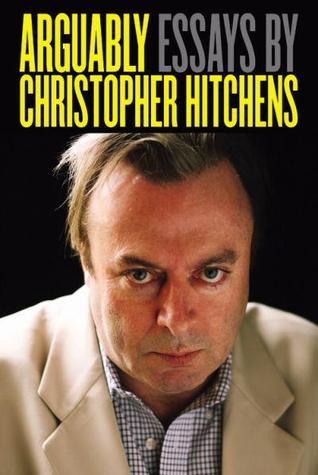
Arguably: Essays
by Christopher Hitchens
I read these essays pick-and-choose style, so I really only read about a fourth of the book, probably. Especially enjoyed the ones about Dickens, Wodehouse, Orwell, and the King James Bible.
From The Dark Side of Dickens:
What did oyster shuckers _do_, Dickens demanded to know, when the succulent bivalves were out of season?
"Did they commit suicide in despair, or wrench open tight drawers and cupboards and hermetically sealed bottles -- for practice? Perhaps they are dentists out of the oyster season? Who knows?"

(This quote is from a private letter. Hitchens notes that “Dickens was almost always ‘on’.”)
Re: Pelham Grenville Wodehouse, I learned that he was in an internment camp in France during WWII for almost a year. After being released, he made some radio broadcasts that were taken as collaboration with the Nazis. It seems (to Hitchens, at least) that he was more likely just in his own world and not especially concerned with what the Nazis were doing.
Orwell’s Animal Farm came very close to not being published at all. It was published in 1945, a time when the alliance between Britain, the US, and the Soviet Union was both critical and tennuous. One publisher agreed to publish it, then backed off after consulting with the UK’s Ministry of Information. According to Wikipedia, the civil servant who warned the publisher not to proceed was later revealed to be a Soviet spy!
Orwell was delighted when friends told him that their kids had read his book because of its subtitle, “A Fairy Story.”
Re: the KJV, I learned that the translation was headed up by a bishop named Lancelot Andrewes. Hitchens describes how phrases from the KJV were universally known among English speakers for a long time. The proliferation of Bible translations has eroded that common language. (He also mentioned a book by T. S. Eliot called For Lancelot Andrews, which I now have requested through inter-library loan.)