438 Days: An Extraordinary True Story of Survival at Sea
November 8, 2019
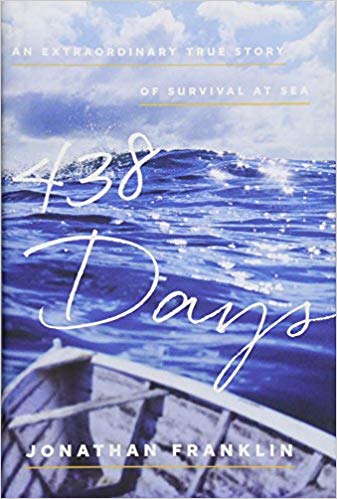
438 Days: An Extraordinary True Story of Survival at Sea
by Jonathan Franklin
Fleeing a small-town murder feud in El Salvador, José Salvador Alvarenga moved to Costa Azul, Mexico. There he became a tiburónador – a “sharker,” fishing 50 to 100 miles from shore, catching shark, tuna, and mahi-mahi on a line with 700 hooks baited with sardines, on a ship the width of a pickup truck and the length of two trucks. (Why are these dimensions given in the unit “pickup trucks?” I don’t know, but it does make it easy to picture.)
On November 17, 2012, he left his normal partner behind and took along a 22-year-old man named Córdoba. In a vicious storm, they were thrown off-course and lost at sea.
They survive by catching fish barehanded, spending most of the day cramped inside the icebox (to keep out of the sun), and talking to cheer each other up. Alvarenga figures out how to catch birds that land on the boat, and he keeps them tied down (with one wing broken) at one end of the boat, so he can kill and eat them when needed. Córdoba lasts a long time but eventually dies of hunger. Alvarenga finds a barrel floating in the water and uses that and some other empty bottles to store a supply of fresh water when it rains, which helps him survive dry spells. He catches a shark (the liver is very nutritious), eats fish eyeballs (rich in Vitamin C!), and pretends the birds are soccer players – Mexico vs. Brazil! He talks to the birds (including a larger one, Pancho, that he makes his pet until he’s forced to eat it or starve), to the ocean, to the dead body of Córdoba (though he later pushes the body overboard), and constructs a psychological virtual reality to inhabit. Going other places in his mind, while kind of crazy, does help him survive.
Eventually, he washes up near the Marshall Islands. Though severely traumatized, he slowly returns to society, eventually getting back to Mexico and reuniting with his 13-year-old daughter Fatima, who he has not seen since she was 1. He goes back to Costa Azul, and it is there that he finally begins to open up and tell his story, speaking to the other sharkers, the people most likely to understand what he went through (and most likely to experience something similar). In the end, he spent a year being interviewed by Jonathan Franklin and hoped that his story would inspire others to always have hope.