Ordinary Men
January 25, 2018
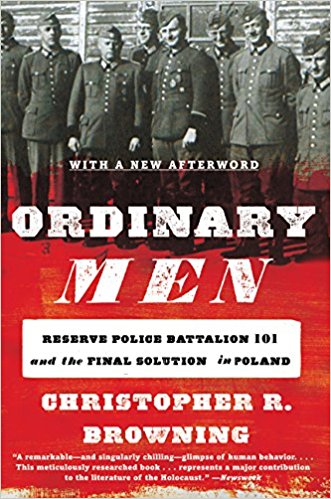
Ordinary Men
by Christopher R. Browning
I heard Jordan Peterson recommend this book in an interview last year. The book examines a particular German police battalion, composed of ordinary men who were conscripted essentially at random, and how they began committing genocide against the Jews in Poland. It was dark and difficult reading, and in the end, his analysis is that we can’t blame these atrocities on any one thing that is peculiarly German (as some others have claimed). Many possible factors are considered:
Factor #1: Wartime brutalization hardened the men. However, Browning points out that they participated in “Jew hunts” when they had never been in a battle. Thus, “brutalization was not the cause but the effect of these men’s behavior.”
Factor #2: Beaurocracy. “…Modern beaurocratic life fosters a functional and physical distancing in the same way that war and negative racial stereotyping promote a psychological distancing between perpetrator and victim.” But this did not apply to Police Battalion 101, since they shot hundreds of unarmed victims at point-blank range. They weren’t killing from behind a desk.
Factor #3: Division of labor. This is related to beaurocracy. Some men dragged Jews out of their houses, others marched them to a specific location, and others did the shooting. If all you were doing was guarding a street, for example, you might convince yourself that you weren’t personally participating in the overall action.
Factor #4: Special selection. Were only murderous killers selected for this duty from the beginning? In this case, definitely not. These were middle-aged, working class men from Hamburg (a city that had not supported the Nazi party to the same extent as other parts of Germany). In fact, since the most politically reliable men had probably been conscripted first, this group would statistically have been less on board with Nazi sentiments.
Factor #5: Psychological explanation. There might be a kind of self-selection, so that “Nazis were cruel because cruel people tended to become Nazis.” Certain people with latent violent tendencies – “sleepers” – may be activated under wartime conditions. Browning doesn’t believe this, at least not as the overall cause, though, and neither do I. These cruel tendencies are present in all of us, and as Browning says, “the real ‘sleeper’ is the rare individual who has the capacity to resist authority and assert moral autonomy but who is seldom aware of this hidden strength until put to the test.”
Factor #6: Situational factors. Browning summarizes the Stanford prison experiment, where a randomly selected group was told to be guards, and the remaining people were called prisoners. The spectrum of behavior observed in the “guards” is eerily similar to the behavior of Police Battalion 101: A group of enthusiastic killers, a larger group of men who helped but did not actively seek opportunities to kill, and a small group (not more than 20%) of men who resisted or evaded having to kill.
Factor #7: Careerism. What if men became killers because they were afraid of the impact on their careers if they refused? This was probably true for some. On the other hand, some who refused to kill felt free to do that because of their (non-police) careers. If you had a good job to come home to, you weren’t worried about being kicked out of the police force.
Factor #8: Following orders. Orders were orders, and if you didn’t follow them, you and your family might end up in a concentration camp or simply shot on the spot. The problem with this explanation is that, according to Browning, “in the past forty-five years, [no one] has been able to document a single case in which refusal to obey an order to kill unarmed civilians resulted in … dire punishment.” You might be bullied or threatened, but that’s all, and in the case of Battalion 101, the commander, Major Trapp, was very willing to allow men not to shoot if they felt they couldn’t.
Factor #9: Obediance to authority. This is related to following orders. When an order comes from above, you may feel that you are not personally responsible for what happens when you follow it. Browning describes the famous Milgram experiment where an authority figure (a scientist) tells someone to pull a lever that will give another person an electric shock. Browning says that there are complicating factors when trying to apply this experiment to explain, for example, the first major killing at the Polish town of Józefów, but “many of Milgram’s insights find graphic confirmation in the behavior and testimony of the men of Reserve Police Battalion 101.”
Factor #10: Conformity/peer pressure. How will everyone see me if I refuse to do this? Personally, I think this is a big one. Milgram observed that people are much more likely to say that they were influenced by authority (factor 9) than by conformity. But that is because this “seems to absolve them of personal responsibility.” Peer pressure was strong. If you refused to kill, you were leaving the dirty work to your comrades. It could also be seen as a moral indictment of what they were doing, so men who refused to shoot would often say something like, “I can’t, I’m too weak,” suggesting that they weren’t “manly” enough to kill starving unarmed people.
Factor #11: Indoctrination. If authority figures “define the situation” for you in a certain way, you may see what you are doing as good. Browning enumerates the various ways the policemen were indoctrinated, but mostly the indoctrination attempts were too late to explain things. The policement had already conducted the Józefów massacre before they received certain pamphlets that might try to explain their actions. On the other hand, German racial superiority had been drummed into them, and it may have played a factor.
It is not possible to point to a single one of these factors as the explanation for the actions of Reserve Police Battalion 101. The reasons they massacred so many Jews are multifaceted, and many seemingly obvious explanations don’t hold up under scrutiny. Browning ends his book with this: “If the men of Reserve Police Battalion 101 could become killers under such circumstances, what group of men cannot?”